

Digital Well-Being
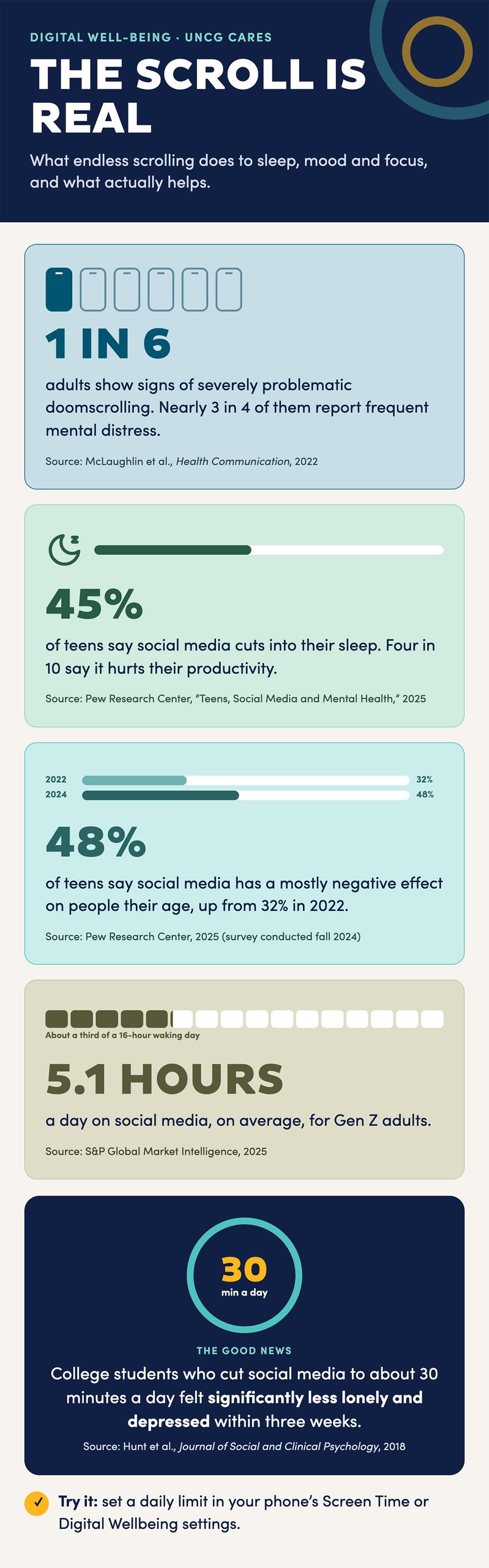
Your phone is part of your health, too. It’s how you stay close to friends and family, find your people on campus, study and unwind. It can also shape your sleep, your focus and how you feel about yourself, often without you noticing.
Digital well-being isn’t about giving up your phone or quitting social media. It’s about using technology in ways that leave you feeling better, not worse, and staying in charge of when and how you use it.
This page offers practical ways to question what you see online, build habits that protect your sleep and focus, use AI tools responsibly, and find support from any device. If time online is weighing on your mood or getting in the way of class, relationships or rest, you don’t have to figure it out alone.
Find support online
Support is available from your phone:
- Make a counseling appointment
- Call or text 988, 24/7
- Text HOME to 741741 for the Crisis Text Line
- Call the NC Peer Warmline, 855-733-7762
- Visit care.uncg.edu from any device

touch grass:
10 things to do instead of doom scrolling
Your thumb has been working overtime. Give it the day off.
- Visit Minerva. She’s been reaching out to Spartans for decades. Don’t leave her on read.
- Touch grass, literally. Peabody Park has plenty, and zero ads.
- Run a College Avenue dog census. It’s your For You page, but in real life.
- Find your Jackson Library spot. Do Not Disturb mode, IRL.
- Turn the group chat into a group hang. “Coffee?” hits different in person.
- Hit the Kaplan Center for Wellness. Rec league era: unlocked.
- Watch the Spartans in 4K. It’s called being there.
- Call someone who’d love to hear from you. The serotonin is mutual.
- Actually go to sleep. Your phone gets a full charge every night. You deserve the same.
- Pull up to Let’s Talk. Real talk, real human, zero algorithm.
Bonus: Put your phone in another room. If you forget where you left it, congrats. You won.